IEC 62133-2:2017 is the most well-known standard for exporting lithium-ion battery, including those used in IT Equipment, GPS, wearable products, smartwatch, Bluetooth devices, wireless sensors, tools, laboratory, household and medical equipment.
What's IEC62133 Certificate of Lithium Battery?
IEC 62133-2:2017 is the most well-known standard for exporting lithium-ion battery, including those used in IT Equipment, GPS, wearable products, smartwatch, Bluetooth devices, wireless sensors, tools, laboratory, household and medical equipment.
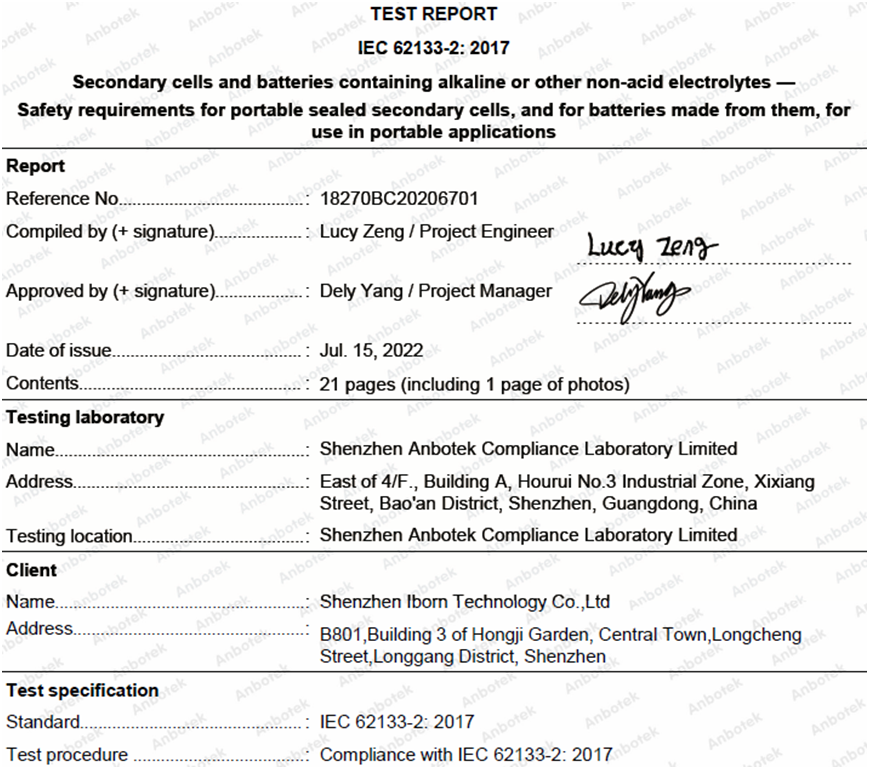
In February 2017, the International Electrotechnical Commission (IEC) officially released the IEC 62133-2:2017, an international safety standard for lithium ion battery products. This standard is mainly for the safety requirements of a single battery and battery packs and portable sealed only cell batteries and battery packs containing alkaline or non-acid electrolytes (including lithium ion polymer batteries, lithium ion(Li-Ion) cells, nickel-hydrogen batteries, nickel-cadmium batteries, etc.). The second edition will have some significant changes related to Lithium-ion Batteries.
Part I: Lithium-ion cells
The second edition of IEC 62133-2:2017 have the most impact on lithium-ion cell manufacturers and dealers, it is also crucial for a company who use the lithium-ion cell. The changes related to lithium polymer cells fall into three categories:
• Cancel redundant tests with other standards
• Transform existing tests
• New requirements
- Cancel Unnecessary Tests with Different Standards
The primary focus is to delete the items covered by the United Nations Manual Of Tests and Criteria (UN38.3). The tests removed are:
- Vibration
- Mechanical Shock
- Low Pressure(Altitude Simulation)
- Cell Protection Against High Rate Charging (not a UN38.3 test)
2.Modify Existing Tests
The most important of these changes are related to how the sample is prepared for testing. In the first edition of the standard, samples were charged at room temperature (20°C ±5°C) according to the manufacturer's recommended charging method. The second edition includes two charging processes: one at room temperature, and one new program at high and low specified operating temperature ranges (10°C and 45°C if not stated). The new charging method also requires charging at the maximum rated charge current of the product. This process only requires samples at the cell level for short circuits, thermal abuse, crushing, and forced quick internal tests. In the constant voltage test, a continuous low-rate charge test was corrected to a constant charge. This modified test requires the battery to be charged for seven days at the manufacturer's recommended charge current and voltage limits.
Modifications to the crash test included clarification of the trial, indicating that the crushing only needs to be done along the broadside of the cell. Also, termination criteria for 10% deformation of cells were also added.
A more significant change is to divide the short circuit into separate parts of the battery and the battery. The second version of the lithium-ion cell was modified to contain only one test temperature and provide a more stringent range of circuit resistances.
- Completely New Requirements
The most significant change in the second edition is the addition of a new test——Forced Internal Short Circuit test. The test procedure very explicitly describes a method that requires the test facility to fully charge a Li-Ion cell, then open it and remove the jellyroll. Once the battery is removed from the can, a small Nickel particle of a specific shape and size is to be placed in a particular location of the cell jellyroll. Following the placement of the particle, the affected jellyroll is to be crushed.
Pate II: Lithium-ion Batteries
For lithium-ion battery manufacturers, the IEC 62133-2:2017 proposal will have less impact on lithium-ion battery manufacturers than battery suppliers. Lithium-ion battery manufacturers' testing and demand will be reduced. The changes related to lithium-ion batteries fall into three categories:
• Revised Charging Procedure
• Reduced Sample Requirement
• New Testing
- Revised Charging Procedure
Related to the cell level charging process changes, the lithium-ion battery level will have a modified charging process, but this will only affect the battery level of a test. This change comes from Japan's lithium-ion battery and battery test requirements, and its states that samples used for short-circuit testing must be charged in an environment which is equal to the ambient temperature upper and lower: assumes 45°C and 10°C if not provided by the manufacturer. All other tested units on the battery level were charged at room temperature (20°C).
- Reduced Sample Requirement
The subcommittee’s test requirements for lithium-ion batteries are more comprehensive than ever. Therefore, the amount of test required by IEC 62133-2:2017 at the battery level has dropped significantly. The testing that has been completely removed as a result of this review is:
- Vibration
• Temperature Cycling
• Mechanical Shock
The result is that the change reduces the required number of samples for testing from 31 for First Edition testing to 21 for Second Edition testing.
- New Test
A new test has also been added to the battery level, designed to simulate the battery charging time longer than the manufacturer's use of a higher charging rate. This test is performed on a fully discharged five battery packs, and the charge the batteries with a current of two times the rated current, and an upper voltage limit that is set to the maximum voltage available from the charger to the battery. If you do not know the charger's maximum voltage, 5 volts per cell (or cell string) will be used. The current is maintained until the maximum charge voltage is reached and the temperature is monitored during the test. The termination of the trial is defined as the temperature is stable, the highest voltage is reached, with acceptance criteria of no fire and no explosion.
Tests Performed (name of test and test clause):
Tests are made with the number of samples specified in Table 2 of IEC 62133-2:2017 (NEW).
Test Items:
Type Test Conditions
Charging procedures for test purpose
Continuous charging at constant voltage (lithium-ion cells)
Molded case stress at a high ambient temperature (lithium-ion battery)
External short circuit (lithium-ion cell)
External short circuit (lithium-ion battery)
Lithium-ion Battery Freefall
Thermal abuse (lithium-ion cell)
Crush (lithium-ion cells)
Over-charging of lithium-ion battery
Forced discharge (lithium-ion cells)
Transport Tests
Test Conclusion:
Lithium-ion Battery submitted by IBORN Battery Co., Ltd. are tested according to IEC 62133-2:2017 Secondary cells and batteries containing alkaline or other non-acid electrolytes Safety requirements for portable sealed seconds cells. And for lithium-ion batteries made from them, for use in portable applications.
4 Parameter measurement tolerances
5 General safety considerations
Lithium-ion cells and lithium-ion batteries subject to intended use be safe and continue to function in all respects. Cells and batteries subject to reasonably foreseeable misuse do not present significant hazards.
5.2 Insulation & Wiring
Insulation Resistance between an accessible metal case (excluding electrical contacts) and positive terminals > 5MO. Internal wiring and insulation are sufficient to withstand maximum anticipated current, voltage and temperature requirements. The orientation of wiring maintains adequate creepage and clearance distances between conductors. The mechanical integrity of internal connections is sufficient to accommodate conditions of reasonably foreseeable misuse.
5.3 Venting
Lithium-ion battery cases and lithium-ion cells incorporate a pressure relief mechanism or are constructed so that they relieve excessive internal pressure at a value and rate that will preclude rupture, explosion, and self-ignition. Venting mechanism exists on a narrow side of pouch cell. Encapsulation used to support lithium-ion cells within an outer casing does not cause the battery to overheat during normal operation no inhibit pressure relief.
5.4 Temperature /Voltage /Current Management
The lithium-ion batteries are designed such that abnormal temperature rise conditions are prevented. Over-discharge, over current and short-circuit proof circuit used in this lithium-ion battery. Means is provided to limit current to safe levels during charge and discharge. The lithium-ion batteries are designed such that within temperature, voltage and current limits specified by the cell manufacturer. Lithium-ion batteries are provided with specifications and charging instructions for equipment manufacturers so that associated chargers are designed to maintain charging within the temperature, voltage and current limits specified.
5.5 Terminal Contacts
Terminals have a clear polarity marking on the external surface of the lithium-ion battery. The size and shape of the terminal contacts ensure that they can carry the maximum anticipated current. External terminal contacts surfaces are formed from conductive materials with good mechanical strength and corrosion resistance. Terminal contacts are arranged to minimize the risk of short circuits.
5.6 Assembly of Lithium-Ion Cells into Lithium-ion Batteries
5.61 If there is more than one lithium-ion battery housed in a single battery case, lithium-ion cells used in the assembly of each battery have closely matched capacities, be of the same design, be of the same chemistry and be from the same manufacturer. Each lithium-ion battery shall have an independent control and protection. Manufacturers of lithium-ion cells make recommendations about current, voltage and temperature limits so that the lithium-ion battery manufacturer/designer may ensure proper design and assembly. Lithium-ion batteries that are designed for the selective discharge of a portion of their series connected lithium-ion cells incorporate separate circuitry to prevent the cell reversal caused by uneven discharges. Protective circuit components are added as appropriate and consideration was given to the end-device application. When testing a lithium-ion battery, the manufacturer of the lithium-ion battery provides a test report confirming the compliance according to this standard. The battery incorporates separate circuitry to prevent lithium-ion cell reversal from uneven charges as the pack is designed for the selective discharge of a portion of its series connected cells.
5.6.2 Design Recommendation for Lithium System Only
For the lithium-ion battery consisting of a single cell or a single cellblock:
charging voltage of the lithium-ion cell does not exceed the upper limit of the charging voltage specified in Clause 8.1.2, Table 4 or Charging voltage of the lithium-ion cell does not exceed the different upper limit of the charging voltage determined through Clause 8.1.2, NOTE1.
5.7 Quality plan
The manufacturer has prepared a quality plan defining the procedures for the inspection of materials, components, lithium-ion cells and lithium-ion batteries and which covers the process of producing each type of lithium-ion cell and lithium-ion battery.
6 Type Test Conditions
Tests were conducted with the number of lithium-ion cells or lithium-ion batteries as outlined in Table 2 of IEC 62133 with lithium-ion cells or lithium-ion batteries that were not more than six months old. Unless noted otherwise in the test methods, thieving was conducted in an ambient of 20°C±5°C.
8 Specific Requirements & Tests
8.1 Charging Procedure for Test Purposes
If a lithium-ion cell’s specified upper or lower charging temperature exceeds values for the upper or lower limit test temperatures of Table 4, the lithium-ion cells were charged at the specified values plus 5°C for the upper limit and minus 5°C for the lower limit. A valid rationale was provided to ensure the safety of the lithium-ion cell.
8.2 Intended Use
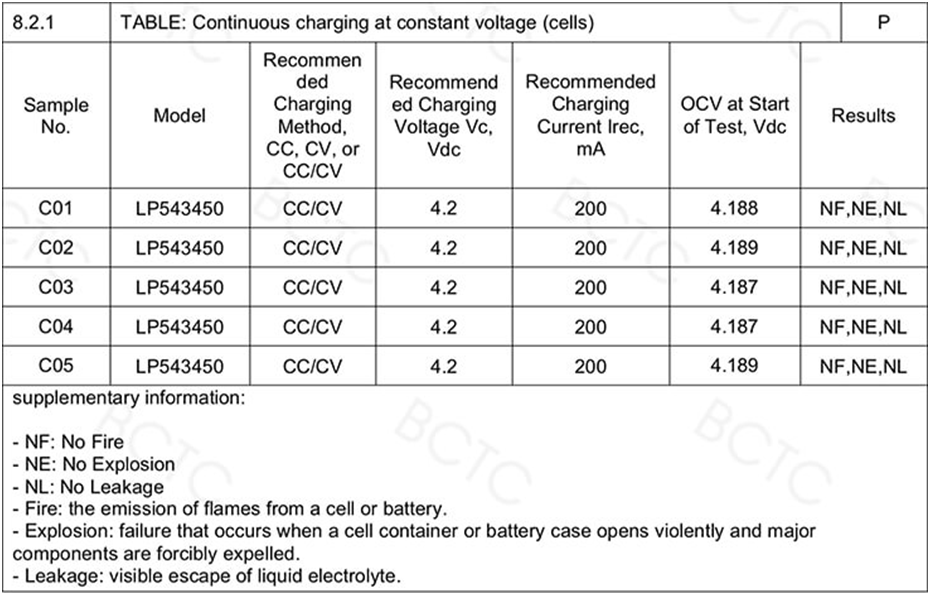
8.2.1 Continuous Charging at Constant Voltage (lithium-ion cells)
Fully charged lithium-ion cells are subjected for 7 days to a charge as specified by the manufacturer.
Results: No fire, no explosion, no leakage
8.2.2 Moulded Case Stress At The High Ambient Temperature (lithium-ion battery)
Fully charged lithium-ion batteries according to the first procedure in 8.1.1, the batteries were placed in an air-circulating oven at a temperature of 75°C±2°C for 7 hours. Afterward, they are removed and allowed to return to room temperature.
8.3 Reasonably Foreseeable Misuse
External short circuit (lithium-ion cell)
The case temperature declined by 20% of the maximum temperature rise
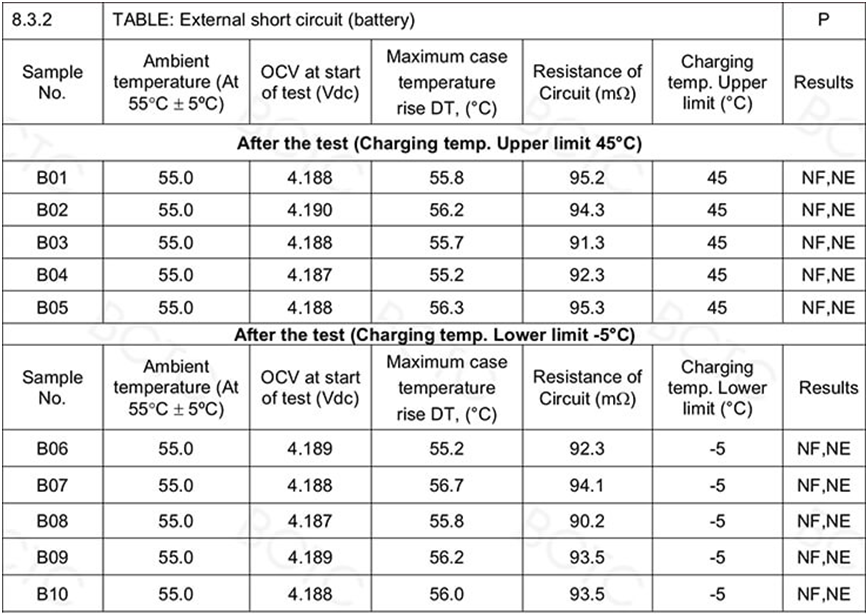
8.3.2 External Short Circuit (lithium-ion battery)
The lithium-ion batteries were tested until not of the following occurred: 24 hours elapsed".
8.3.3 Freefall
The ambient temperature of 20°C±5°C.
Fully charged lithium ion cells or batteries were dropped 3 times from a height of 1.0m onto a concrete floor. After the test, the lithium-ion cell or battery shall be put on rest for a minimum of one hour and then a visual inspection shall be performed.
Results: No fire, no explosion
8.3.4 Thermal abuse (lithium-ion cells)
The lithium-ion cells were held at 130°C±2°C for 10 minutes.
Results: No fire. No explosion"
8.3.5 Crush (lithium-ion cells)
Each fully charged lithium-ion cell, charged according to the second procedure at the upper limit charging temperature in 8.1.2, is immediately transferred and crushed between two flat surfaces in an ambient temperature. The crushing force was released upon: The maximum force of 13 kN ±1 kN has been applied.
Results: No fire. No explosion
8.3.6 Over-Charging Of Lithium-Ion Battery
The test was continued until the temperature of the outer casing: Reached steady-state conditions (less than10°C charge in 30 minute period), or Returned to ambient.
Results: No fire. No explosion
8.3.8 Transport Test
Regulations concerning the international transport of lithium-ion batteries are based on the UN Recommendations on the transport of dangerous goods. Testing requirements are defined in the UN Manual of Tests & Criteria.
9 Information for Safety
The manufacturer of secondary cells ensures that information is provided about current, voltage and temperature limits of their products. The manufacturer of Lithium-ion Battery ensures that equipment manufacturers and, in the case of direct sales, end-users are provided with information to minimize and mitigate hazards.
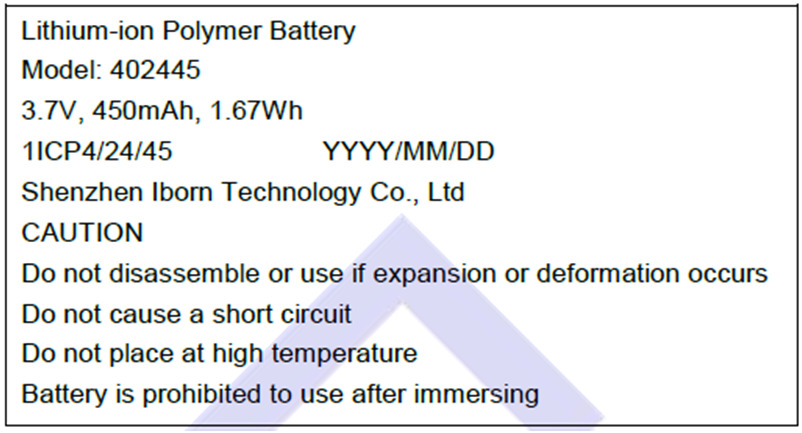
10.2 Lithium-Ion Battery Marking
Lithium-ion Battery marked in accordance with the requirements for the cells from which they are assembled. Lithium-ion Battery marked with an appropriate caution statement.
11 Lithium-ion Battery Packaging
Lithium-ion Cells or batteries were provided with packaging that was adequate to avoid mechanical damage during transport, handling and stacking. The materials and pack design were chosen to prevent the development of unintentional conduction, corrosion of the terminal and ingress of moisture.
FAQs of IEC62133 certificate
1 ) What’s the difference with IEC 62133 and EN 62133?
The main difference between IEC 62133 and EN 62133 is that the certification body is different, EN is the standard of the European Union, the IEC is the standard, the test content is the same. Founded in 1906, the Electron Council (IEC 62133) is the world’s first electron standardization body responsible for standardization in the field of electrical and electronic engineering. The purpose of the IEC 62133 is to promote standardization and cooperation in the field of electrical and electronic engineering and to enhance mutual understanding.
EN: European Norm, European standard. CENELEC and CENELEC and their joint agency, CEN/CENELEC, are the leading standard-setting bodies in Europe, and CENELEC was established in 1976 in Brussels, Belgium, by the merger of two early institutions. Its purpose is to harmony with the electro-electric standards issued by the standards bodies of the countries concerned in Europe and to remove technical barriers to trade.
IEC/EN62133 Certified Standard Range: Safety requirements for rechargeable batteries and battery packs, alkaline or other non-acidic electrolytes/sealed portable batteries. Test items include: continuous low multiply charging, vibration, high temperature die shell stress, high and low temperature cycle, anti-charging (nickel), external short circuit, free drop, mechanical impact, thermal abuse, extrusion, low pressure, overcharge (nickel, lithium electricity different) forced discharge, high multiply charging.
2) Is the old version of the standard (IEC 62133 :2012) still valid after the new version of the standard comes out?
A: The IEC 62133 standard does not have a clear validity period in principle, the old and new versions of the standard can be used in parallel, such as at this stage can also apply for IEC62133:2012 version of the report and certificate, but the new standard is more accurate than the old standard, more comprehensive analysis of battery safety and performance.
In general, terminal chambers using lithium batteries will adopt the certification and CB test reports of the new standards in a timely manner, while IEC 62133 member countries around the world will gradually adopt the new standards. Customers are advised to start applying for certificates and test reports for the new version of the standard to facilitate compliance with the new standards in the international market.
3) Is IEC 62133 sufficient to CE-mark on lithium batteries?
First it is important to note that only certain European directives govern “CE-marking” of products. In general, portable batteries within the scope of IEC 62133 do not fall under the scope of the CE-marking directives.
The major exception is for Smart batteries which contain active electronics; such batteries may fall under the scope of the EMC directive (and EMC specific standards). EN 62133 (the EU-adopted version of IEC 62133), covers electrical safety.
IEC 62133 2nd edition referenced the UN 38.3 Transportation tests. Are these required for both Cell and Battery (Packs)?
Therefore, it was considered redundant to include these requirements as part of the electrical safety test. The 2nd edition only specifically requires these tests for cells (per section 6, Table 2).
It should be noted that the UN 38.3 requirements do not require individual cells to be tested to the T1-T4 tests (“component cells” may be tested within a battery, rather than individually).
Therefore, to be considered compliant with IEC 62133 2nd edition, the cells shall have been tested individually.
4 ) Our batteries is under 100watthours. Can we exempt from IEC 62133 certification testing?
The 100 watt hour limit is related to certain packaging, labeling, and shipping requirements and exceptions. Such batteries must still meet the UN 38.3 Transportation tests to qualify for these shipping exceptions. As for IEC 62133, there is no minimum/maximum capacity. If a rechargeable Lithium-ion battery is user-replaceable, portable, or used to power a portable device, then IEC 62133 would apply. Again, certification may or may not be mandatory, depending on the market and end products where the battery is used.
For standard or customized lithium battery solutions ,please feel free to send your enquiry to us .
www.iBornBattery.com

